






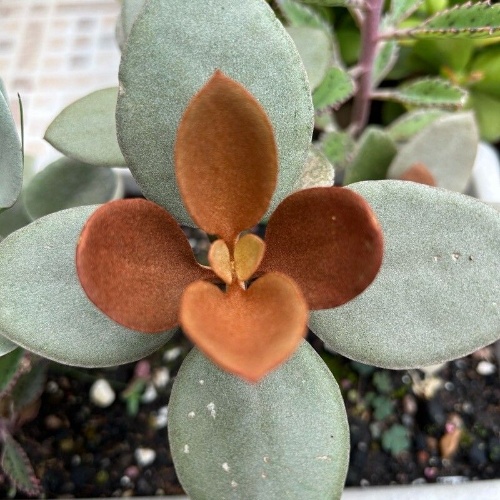


How to grow and care for Kalanchoe orgyalis Baker
plant care guide about watering, fertilizing, trimming, repotting, cutting, propagating Kalanchoe orgyalis Baker, Leather plant
Kalanchoe orgyalis Baker 101 - Plant Care Instructions
Bright direct light
18C° ~25C°
Every 21 days
Growth Observation wiki
cormlet

Botany Encyclopedia
Family : Crassulaceae
🌿 Photosynthesis
They use CAM (Crassulacean Acid Metabolism) photosynthesis, common in desert plants. This means they close their stomata during the day to minimize water loss and carry out photosynthesis at night. It's best to water them at night. However, they are sensitive to overwatering, so they should be kept in a well-ventilated environment without excess moisture.
Genus : Kalanchoe
🏝️ Habitat Conditions
This plant grows in the tropical regions of Madagascar. It prefers warm environments and is sensitive to cold.
🪨 Soil Mix
Drought-tolerant plants should be planted in well-draining soil. For succulents, typically mix potting soil and pumice in a 3:7 ratio. However, this ratio may vary depending on the situation and environment.
🌡️ Environment
The ideal temperature is between 16°C and 26°C, with a minimum of 10°C. It's best to keep them indoors during winter. They thrive well in typical indoor humidity.
👀 Characteristics details
Succulents store water in their leaves, making them drought-resistant. Overwatering can occur if you water them too frequently. If the leaves become wrinkled, it's a sign of water deficiency, so it's best to water them at that time.
☀️ Light
This plant loves light. Ensure it receives plenty of it.
💧 Water
Water the plant when the soil is dry. Be careful not to overwater, as it can lead to waterlogging. After watering, if droplets remain on the leaves for too long, they can cause damage. It's best to place the plant in a well-ventilated area or gently wipe off the droplets.
🌱 Propagate
Use sterilized tools to cut a stem with at least one node at an angle, dry it for 3-4 hours, then propagate in soil or water. 1. For water propagation, avoid transparent containers. Place the stem in water, and once roots appear, use hydroponic fertilizer. When roots are 5-7 cm long, transfer to soil. 2. For soil propagation, plant deeply in soil without fertilizer. After planting, avoid bright light and gradually increase exposure to soft light. Maintain high humidity and a temperature of 20-25°C.
🪴 Repot
Repot healthy plants every two years in spring, as they do not grow quickly. Water them 4-7 days after repotting, not immediately.
💊 Fertilize
This plant doesn't require much fertilizer, but it's good to fertilize once a month from spring to summer. After flowering, it's beneficial to fertilize to replenish nutrients used during blooming. Avoid fertilizing immediately after repotting; wait 2-4 weeks before doing so.
🌺 Flower
It usually blooms in winter, but indoors, it can bloom anytime if the conditions are right. To see flowers, provide 12-14 hours of darkness for about 6 weeks in winter. Typically, this is done by covering the plant with a box. Once the flowers wilt, cut the flower stalk to prevent further nutrient consumption.
😵 Toxicity
Be cautious with pets and young children as it is toxic.
water
How to water Kalanchoe orgyalis Baker
How often should I water?
check Kalanchoe orgyalis Baker Every 21 days if it needs water when it’s very cold (below 5℃), water less frequently
When do I need to water?
The soil should be at least 90% dry before watering again. this means about every 2 weeks in the warm season and about every 4 weeks in the cold season
Signs that it really needs water
leaves look a little wrinkled
When is the Dormant period?
it goes into dormancy in the Summer. during the period, 1.5~2x the watering interval you use in the warm season.
Light & Location
How much light does a Kalanchoe orgyalis Baker need?

Bright direct light
Grow light
Light preference
Kalanchoe orgyalis Baker likes Bright direct light, Grow light day. The brighter the space, the better this plant grows.
Check if there’s an optimal place in your house!
This plant prefers
2K ~ 20K lux to thrive!
0
20K~
2K
20K
Temperature
Natural habitat
-15
8~40℃
45
Houseplants
-15
18~25℃
45
Plants that grow in the wild and those that grow indoors prefer different temperatures. If you grow Kalanchoe orgyalis Baker at home, make sure the temperature is 18~25℃.
Humidity
Ideal humidity
0
40~70%
100
Kalanchoe orgyalis Baker prefers humidity about 40~70%. If necessary, increase humidity by misting, humidifier.
Fertilize
Collective Knowhow
When should I fertilize?
Only when your plant is healthy
How frequently should I fertilize?
1-2 times in growing season. A pinch for a small pot.
Characteristic
The taxonomic classification of Kalanchoe orgyalis Baker is as follows. - Kingdom: Plantae, Phylum: Tracheophyta, Class: Magnoliopsida, Order: Saxifragales, Family: Crassulaceae, Genus: Kalanchoe, Species: Kalanchoe orgyalis
| Characteristic Name | Characteristic Value |
|---|---|
| Lifespan | Perennial |
| Habitat | Africa |
| Taxonomy Name | Taxonomy Value |
|---|---|
| Phylum | Tracheophyta |
| Class | Magnoliopsida |
| Order | Saxifragales |
| Family | Crassulaceae |
| Genus | Kalanchoe |
| Species | Kalanchoe orgyalis |
Is Kalanchoe orgyalis Baker toxic?
Kalanchoe orgyalis Baker is dangerous to Cat, Hamster, Dog
Cat
Hamster
Dog
Is your plant sick?
Track what happened. We’ll let you know the cause and treatment shortly!


1:1 Expert Help
You’ll get professional feedback within 24 hours from an expert on our team.
feedback will include